
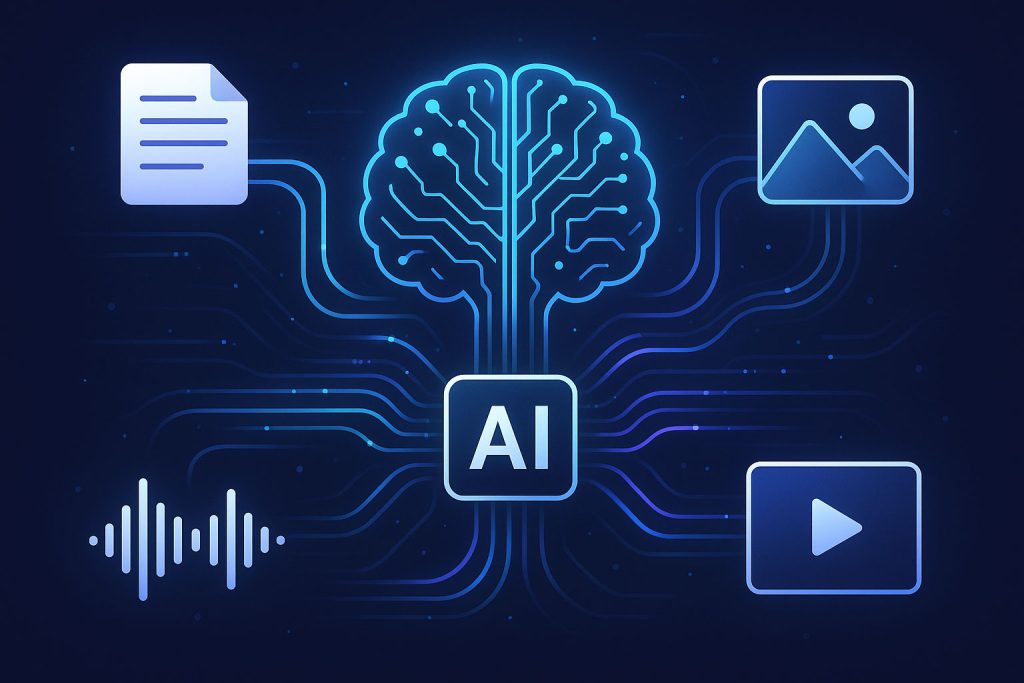
Artificial Intelligence has taken another quantum leap forward, and this time it’s about breaking down the barriers between different types of data. Welcome to the era of Multimodal AI – arguably the most transformative AI trend of 2025 that’s reshaping how machines understand and interact with our world.
What is Multimodal AI?
Unlike traditional AI models that focused on processing a single type of data – whether text, images, or audio – multimodal AI systems can simultaneously understand and process multiple data formats. Think of it as giving AI the ability to see, hear, read, and comprehend just like humans do, but with unprecedented speed and accuracy.
This breakthrough represents a fundamental shift from the specialized, single-purpose AI tools we’ve grown accustomed to. Multimodal AI combines text, visual, audio, and video inputs to create a more comprehensive understanding of complex scenarios, making AI interactions more natural and intuitive than ever before.
Why Multimodal AI is Dominating 2025
The ChatGPT-4 Revolution
The most prominent example of multimodal AI in action is OpenAI’s ChatGPT-4, which can now generate text responses from text, audio, and visual inputs. Imagine uploading a photo of your refrigerator’s contents and asking it to create a recipe – that’s multimodal AI at work. This capability demonstrates how AI can now bridge different sensory inputs to provide contextually relevant responses.
Beyond Single-Format Limitations
Traditional AI models were like specialists – excellent at one thing but limited in scope. A text-based AI couldn’t understand images, and image recognition systems couldn’t process spoken commands. Multimodal AI breaks these silos, creating systems that can:
- Analyze financial documents while simultaneously processing market trend visualizations
- Understand customer feedback from text reviews, voice calls, and product photos
- Generate comprehensive reports that incorporate data from spreadsheets, images, and audio transcripts
Real-World Applications Transforming Industries
Healthcare: A New Era of Diagnostic Precision
In healthcare, multimodal AI is revolutionizing diagnostic capabilities. AI systems can now analyze medical images, patient records, and audio descriptions from doctors to provide more accurate diagnoses. Microsoft and Paige are developing what could be the world’s largest image-based AI model specifically designed to fight cancer by processing multiple data types simultaneously.
Financial Services: Comprehensive Risk Assessment
Financial institutions are leveraging multimodal AI to analyze market trends by processing:
- Traditional financial statements and numerical data
- News articles and social media sentiment
- Video content from earnings calls
- Audio analysis of executive communications
This comprehensive approach enables more accurate risk assessment and investment decisions than single-source analysis ever could.
E-commerce: Personalization at Scale
Retail giants are using multimodal AI to create hyper-personalized shopping experiences by analyzing:
- Text-based browsing history and search queries
- Image preferences from saved photos and pins
- Audio feedback from customer service interactions
- Video engagement patterns from product demonstrations
This multi-dimensional approach allows retailers to understand customer intent far better than traditional recommendation engines.
The Technical Breakthrough Behind the Magic
Small Language Models (SLMs) Democratizing Access
One of the most exciting developments in multimodal AI is the emergence of Small Language Models (SLMs). These models pack several billion parameters while requiring fewer computing resources, making multimodal AI accessible even on smartphones and personal devices.
Microsoft’s Phi and Orca models exemplify this trend, demonstrating that you don’t always need massive computational power to achieve impressive multimodal results. This democratization means that small businesses and individual developers can now implement sophisticated AI solutions without enormous infrastructure investments.
Customizable AI for Specialized Industries
The trend toward customizable multimodal AI is particularly significant for specialized sectors like healthcare, legal services, and financial institutions. These industries benefit from tailored AI systems that understand their specific terminology, compliance requirements, and operational contexts.
Challenges and Considerations
The Shadow AI Phenomenon
As multimodal AI becomes more accessible, organizations face the challenge of “Shadow AI” – employees using AI tools without proper oversight or approval. Recent surveys show that 90% of desk workers now use at least one AI technology, often without their IT department’s knowledge.
This trend raises important questions about:
- Data security and proprietary information protection
- Compliance with industry regulations
- Quality control and result accuracy
- Training and best practice implementation
Regulatory Landscape and Ethics
The rapid advancement of multimodal AI has prompted increased attention to AI regulation and ethics. The European Union has been working on comprehensive AI legislation, and California began enforcing several AI laws in January 2025, focusing on areas like consumer privacy and deepfake technology.
Key regulatory concerns include:
- Algorithmic bias across different data types
- Privacy protection when processing multiple data sources
- Transparency in AI decision-making processes
- Accountability for AI-generated outcomes
Looking Ahead: The Future of Human-AI Interaction
Scientific Research Acceleration
Multimodal AI is poised to accelerate scientific breakthroughs significantly. Google’s recent unveiling of an “AI co-scientist system” demonstrates how these systems can assist researchers in uncovering new knowledge by processing vast amounts of diverse scientific data simultaneously.
Enhanced Customer Service
The integration of multimodal AI into customer service is creating more sophisticated support systems. AI can now:
- Analyze customer sentiment from voice tone and text content
- Provide visual solutions by processing screenshot or video submissions
- Generate comprehensive responses that address multiple aspects of customer queries
Workplace Transformation
IT leaders project that 20% of their tech budgets will be devoted to AI in 2025, with the majority focusing on multimodal applications. This investment reflects the technology’s potential to automate complex tasks that previously required human intervention across multiple data types.
Practical Implementation Strategies
Start Small, Scale Smart
Organizations looking to implement multimodal AI should consider:
- Identify specific use cases where multiple data types converge
- Pilot programs with clear success metrics
- Staff training on AI tool usage and best practices
- Gradual integration with existing systems and workflows
- Continuous monitoring for bias, accuracy, and performance
Building AI Literacy
As multimodal AI becomes ubiquitous, building organizational AI literacy becomes crucial. This includes understanding:
- Data quality requirements across different input types
- Prompt engineering for optimal results
- Result interpretation and validation techniques
- Ethical considerations in AI deployment
Conclusion: Embracing the Multimodal Future
Multimodal AI represents more than just a technological advancement – it’s a fundamental shift toward more natural, intuitive human-computer interaction. As we move through 2025, organizations that successfully harness this technology will gain significant competitive advantages through enhanced decision-making, improved customer experiences, and streamlined operations.
The key to success lies not just in adopting multimodal AI, but in implementing it thoughtfully with proper governance, training, and ethical considerations. As this technology continues to evolve, those who embrace its potential while managing its challenges will be best positioned to thrive in an increasingly AI-driven world.
The future of AI isn’t just about making machines smarter – it’s about making them understand our world the way we do, across all the rich, diverse ways we communicate and share information. Multimodal AI is bringing us one step closer to that future, one interaction at a time.